
CANAL & RIVER TRUST wants to fit tracking devices to boaters' homes in draconian new policy proposals, state National Bargee Travellers Association.
It tells the Canal & River Trust's (CRT) Licence Review Commission report has been published, and has immediately met with condemnation from boaters.
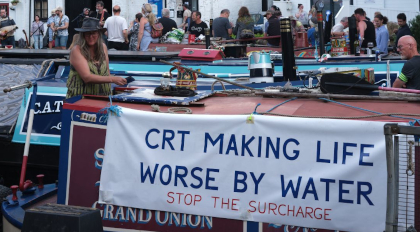
Proposals in the report include forcing boats to fit GPS trackers to enforce compliance, even more bureaucratic rules for boat owners, and the granting of greater enforcement powers to CRT including making it easier to fine, tow or even evict boat owners from their homes.
This series of worrying and possibly illegal departures from the current status quo could lead to a further decline of the waterways and the end of the travelling boaters' way of life.
 What does the report recommend?
The 82 page report, which can be found here, makes 36 recommendations around topics including boater movement requirements, enforcement, issue of licences and other assorted issues of ‘relationships and communications’.
Although the three person commission responsible for the report is billed as ‘independent’, it was staffed by a trustee of CRT, included no representative from the travelling boating community with whom it is primarily concerned, and started its ‘investigation’ based on a biased CRT Terms of Reference document which described travelling boaters as a challenge ‘from an operational, financial and reputational perspective’.
Among the most concerning recommendations to come out of the report is the claim that 'the Trust should have the right to fit a tracking device to any vessel where there is clear evidence of a failure to comply with movement requirements'. This would mark a major escalation in the charity’s approach to their boater customer base, and raises serious concerns over boaters’ right to privacy, GDPR and whether it is appropriate for an unaccountable charity to remotely track private individuals.
The report also claims that CRT should have greater enforcement powers to remove boaters from their homes, including towing boats away within a month of non-payment of fines, and even the use of ‘reasonable force’ in eviction proceedings. Again, this suggests that this charitable body could be gearing up for a wave of possibly violent evictions as they seek to remove boaters from the waterways. Sadly, this comes as no surprise to many boaters who have had to deal with increasingly aggressive CRT enforcement for years, alongside opaque monitoring systems which have seen many compliant boaters spuriously accused of failing to meet their licence requirements. The aforementioned ‘Terms of Reference’ noted CRT’s frustrations at having to comply with the Human Rights (1998) and Equality (2010) Acts in their enforcement proceedings—these new policies send a clear signal that this unaccountable charity wishes to pursue their targeting of the boater population with authoritarian force.
Relatedly, the report suggests that CRT should have the right to refuse to issue licences, specifically on the basis of ‘suitability for navigation’. This would give CRT new powers to restrict not just the number of boats on the waterways, but the types of boats that they deem suitable. Bearing in mind that all boats already require an independently administered Boat Safety Scheme Certificate (BSS) in order to be licenced, this recommendation opens the door to CRT refusing licences to boats CRT deems undesirable for whatever reason—a recipe for an increase in the social cleansing of lower income and vulnerable boaters from the waterways which the charity has already been engaged in for years.
In a final ironic twist, the report also recommends that CRT repair their relationship with liveaboard boaters, suggesting that they provide funding to set-up another independent charity to advocate for them. Given the amount of time CRT spends complaining about their funding, and the fact that they frequently refuse to meet with boaters or boater organisations—with their Head of Boating, Matthew Symonds, referring to this section of their customer base as ‘gits’—many boaters are incredulous at the idea of creating yet another layer of bureaucracy to manage this damaged relationship.
What are the real issues?
Boaters are particularly frustrated by these recommendations because, according to the CRT’s own survey on boat licencing held last year, the vast majority of respondents did not list boat licencing reform as a priority, and instead wanted to see the charity ‘get back to basics’ and deal with the declining maintenance of the canals. The NBTA’s full press release on this survey can be read here, but in essence:
* Results showed that more than 8 in 10 were frustrated with the day-to-day management of CRT waterways in the UK.
* Over 60% of respondents were frustrated about maintenance https://bargee-traveller.org.uk/national-survey-results-show-crt-failing-to-get-the-basics-right/—including of towpaths and banks, management of water supply and a lack of investment in infrastructure—making this the biggest issue raised in the report.
* Despite CRT scapegoating the rise in itinerant boat dwellers, only 1 in 20 surveyed saw overcrowding on the waterways as an issue.
* 9 in 10 did not support legislative change, despite this being a key requirement of many of the new recommendations.
[Our publishing in the past by Allan Richards how the trust manipulated its results from another survey, we simply thought it a waste to take part in the survey even though boaters ourselves—Editor.]
This article by the National Bargee Travellers Association will continue tomorrow with a recent feature by Novara Media that investigated the many issues that boaters face in their relationship with CRT, including the spiralling costs of boat licences, aggressive enforcement and the almost total neglect of waterside facilities like bins, toilets, water points and pump outs.