
THE recent consultation concerning hire boats and the Boat Safety Scheme (BSS) has resulted in tougher regulations for the hire boat industry.
However, such are the additions to the existing rules that it has been decided to give hirers an extra year to implement the many changes, so instead of coming into force next year, they will not do so until April 2017.
The new requirement
There are now new requirements for suitable smoke alarms on sleep‐aboard hire boats and carbon monoxide alarms on hire boats with solid fuel stoves; as well as labels identifying secondary means of escape where the exits are not self‐evident.
There are additional new proposals for warning signs or deck markings of the area where there is the risk of being knocked overboard by an uncontrolled swing of the tiller arm on narrowboat style craft.
Canaltime hirer killed
This latter comes after a Canaltime hirer reversing at Alrewas hit the bank, with the tiller slinging him into the canal where he was caught by the spinning propeller and died. Shortly after, all Canaltime boats had a yellow line painted across the stern deck showing where to stand when reversing, but these were soon obliterated and never replaced. So perhaps the new ruling is to replace the line on all hire boats.
The new regulations include a requirement for a Crew Area and Access Limitation Label in view of all main helm positions on all hire boats and that any crew areas should have slip‐resistant surfaces.
Limit persons and access areas
‘Crew areas' will need to be identified by hire operators for each boat, in support of the testing of stability/freeboard requirements. Crew areas are intended to limit the total numbers of persons on the hire boat and limit where hirers can go on the boat or may limit the numbers on the cabin roof perhaps or on side decks.
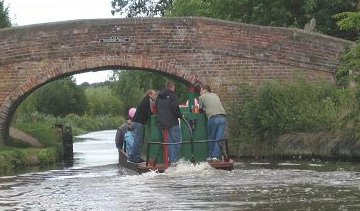 The rules really need to be brought in to prevents hirers, mostly all male crews, hanging on to boats on the gunwale, where we have reported men falling off into the waterways.
The hire operator in setting the extent of the permissible ‘crew area' will determine the areas where slip‐resistant surfaces need to be applied and where handrail requirements apply.
Hirers accept responsibility
The principle underpinning the introduction of signage is the shared responsibility of hirers taking on board and adhering to the guidance at handover as well as any signs augmenting that handover. This means that hirers must also accept responsibility for the consequences of their actions.
Other requirements are that the fuel fuel tank vent hose connections must be accessible for inspection, high‐pressure diesel fuel lines between injection pumps and injectors must be constructed of metallic pipe and not to be made of hose material, checks on mains power sockets and connectors, and a check that there is the presence of a consumer unit on 230V systems.
Portable fire extinguishers to be in open view, or their location clearly marked and more stringent rules for gas lockers checking for any path for leaked LPG to enter the interior of the vessel.
Clarifications or improvements
Clarifications or improvements of some existing BSS hire boat standards are to be adopted, that include that weed hatches should now apply to bow thruster that can be opened by hirers. The requirement for a means of reversing, will include outboard motors The handrail/guardrail requirement will be aligned with ISO 15085 and include ‘handholds' at designated crew areas.
The required lifebuoy(s) should be in good condition. The required fire blanket should be permanently fixed in open view.
Adopt as soon as possible
The BSS and navigation authorities are encouraging hire craft operators, people who hire boats and members of the marine trade to adopt the changes as soon as possible to help address the identified associated risks.
The final versions of the new BSS requirements and their supporting checking procedures will be posted on the BSS website later this year and will be available to be saved to computers or printed out.