
AS YOU most likely can imagine, we have taken a great many photos over the 20 or so years we have been boating and even more gleaned by narrowboatworld in the 16 years of its publication.
These are from countless sources in addition to our regular contributors, all nicely arranged in their various sections.
Having a peep at one such section named 'Sunken' I counted photographs of 206 sunken boats, which of course can only be a small proportion, we obviously not being privy to them all, as boaters, would you believe, don't like the knowledge that they are daft enough to sink their boat being publicised.
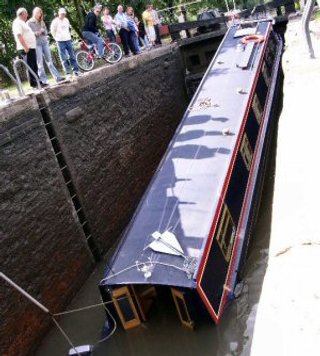 But to the point. Nearly all of them have been caught on the cill, exactly like the one in the photograph that yours truly himself took whilst waiting to go through Weston broad lock on the Trent & Mersey, and of course like, if I remember correctly, 23 others also waiting, though luckily we had arrived as the thing was about to be removed.
Going through the photographs more clearly, though it is impossible to be certain, I can tell you that around 150 of them were so caught on the cill, which begs the question—why?
Obviously the boaters—mostly hirers, as the one in the photograph, though a few private—do not recognise the real danger of the cill. Our first three forages into boating were on hire boats, and though the very first one on the Leeds & Liverpool resulted in our being taken through a lock, it was 'uphill' so any mention of a cill just did not register. Having told the second and third hirers we had hired before, they simply took our word for it and let us loose.
On some hire boats—Canaltime especially—there is a notice stating to go slow past moored boats, but ner a mention of what I believe is surely more important—keeping to the front of the lock when descending. After all the word 'cill' on the ground—Cart's only reference to that most dangerous part of a lock, is hardly adequate.
The answer?
I am fully aware that the boat hiring industry do not want to give any importance to the dangers of boating especially if it results in informing their customers that the boat could be sunk!
But really, the cost and the inconvenience—not only to the hirers, but others too held up by sunken boats—when a simple notice on the stern bulkhead telling hirers to always have the boat at the front of the lock when descending, will most likely cut the sinkings drastically and save many a a ruined holiday, especially as the last couple of sunken boats have taken over a week to be raised...
Cart
Also, the word 'cill', painted on the ground but often obliterated is no real warning of the dangers of the boat being caught.
Though only too fond of its many unnecessary notices, it really is about time that a more dominant warning be introduced by Cart of the dangers of a boat being caught on the cill.
We all know that it doesn't want to emphasise anything that may show a danger, but sinking boats are dangerous, as the death of a boater in a sunken boat earlier this month shows, and it really is time it should be sensible and make the danger more obvious.
Why?
One other point—what happened to that much vaunted promise from Cart that sunken boats will now be raised within 24 hours owing to a contract with River Canal Rescue?
As I mentioned above, a recent one took over a week, so this certainly does not 'clear the waterway for boats to quickly proceed' does it?
Eh?
I should imaging most of you will have seen the news item in various newspapers that Cart have opened a way for canoeists to actually be now able to paddle from coast to coast.
This reads as thought a new waterway has been opened to enable this to happen using the Leeds & Liverpool Canal, but forgive me for mentioning it, but the Leeds & Liverpool and Aire & Calder has been available for years, either to the Ribble or later into Liverpool when the Liverpool Link was opened, and I don't remember any restrictions for canoeists.
And I well remember a 'coast to coast' paddle using the Kennet & Avon and Thames—so what's new? What is it all about I ask?
Victor Swift