
Claiming to be able to better Telford's and Jessop's embankment is pure speculation I would suggest. Where is the proof? Asks Ralph Freeman BSc(Hons)
Whitchurch embankment—modern engineering old foundations
The Canal & River Trust recently announced that the reconstruction of the collapsed Llangollen Canal embankment will employ modern engineering techniques unavailable to the original builders more than 200 years ago.
According to CRT, reinforced layers within the new embankment will improve its long-term strength and resilience, protecting the waterway against extreme weather and climate change.
It sounds reassuring, but does it address the fundamental engineering issues?
Is not that suggestion pure speculation I ask ? Where is the proof?
Old foundations, new embankment
The first point worth remembering is that the new embankment is being constructed on the remains of the original structure. The underlying ground conditions have not changed, nor the critical base of the embankment.
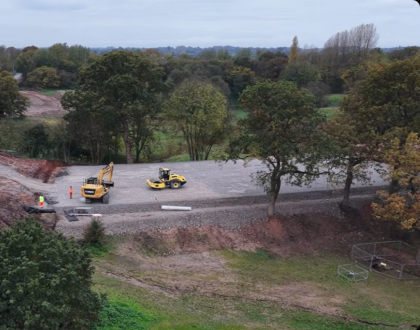 More worrying is the basic mechanisms that can cause the original section to fail have not changed either.
The original engineers were working on unstable glacial deposits, with solid bedrock many feet below.
Their solution was a relatively flexible earth embankment incorporating a clay water-retaining structure.
The modern reconstruction introduces reinforced materials and a substantial concrete canal trough.
While these may improve the strength of the upper structure, they do not automatically improve the stability of the ground beneath it.
Indeed, a stiffer and potentially heavier structure may introduce additional stresses into foundations that have already experienced a catastrophic failure.
Two hundred years old and still working
Beneath the embankment are two original culverts, constructed approximately 220 years ago to carry watercourses beneath the canal. These survived the breach and, following inspections, have apparently been considered suitable for retention.
However, the reconstructed embankment and concrete trough may impose greater loads on these historic structures and the ground supporting them.
Have the culverts and their foundations been assessed against the additional loading? What allowance has been made for differential settlement between the old masonry and the new reinforced construction?
Reinforcing an embankment does not necessarily strengthen what lies underneath it.
The hundred year concrete trough
The new concrete trough raises another interesting question: how long is it expected to last?
Modern reinforced concrete civil engineering structures are commonly designed for a working life of around 100 years, although actual service life depends on design, materials, exposure and maintenance. (Some structures built in the 70's have already failed.)
That is considerably less than the 220 years already achieved by the original clay construction.
Then there are the expansion joints and seals between concrete sections.
These are particularly important because the trough must remain watertight despite thermal movement, settlement and structural deflection.
Joint sealants and waterproofing materials do not necessarily share the design life of the concrete itself. Depending on their type and exposure, some may require replacement after several decades. Even 50 years would be an optimistic assumption for certain sealing systems without maintenance.
How will these joints be inspected, maintained and eventually replaced? Will that require draining the canal and undertaking further major engineering works?
The original clay construction had one considerable advantage: it could accommodate a degree of movement without necessarily losing its watertight integrity. Concrete is rather less forgiving.
Has the original cause been eliminated?
Perhaps the most important question remains unanswered.
What caused the original embankment to collapse?
If water penetrated the structure and travelled through the underlying material, progressively removing support, then reinforcing the upper embankment does not necessarily eliminate that failure mechanism.
The original culverts, their clay surrounds and the underlying ground remain part of the reconstructed structure.
Unless the original water ingress and erosion mechanisms have been positively identified and addressed, there is a risk that the same processes could recur beneath a considerably more expensive reconstruction.
A concrete trough may prevent leakage through the canal bed, but it does not automatically prevent water entering the embankment from elsewhere e.g the nearby lift bridge wash walls.
Modern does not automatically mean better
Nobody disputes that engineering materials and construction methods have advanced enormously over the past two centuries. But the original canal engineers understood something equally important: structures must work with the ground on which they stand.
Their earth and clay embankments were not simply primitive alternatives to reinforced concrete. They were engineering solutions developed for the materials, ground conditions and construction methods available.
Many have survived for more than two centuries, which must prove the soundness of the design?
The question is not whether modern engineering can produce a stronger embankment.
Undoubtedly it can. The critical point is whether that additional strength addresses the actual cause of failure, and whether the new structure will remain serviceable as its foundations settle, its concrete ages and its joints deteriorate.
CRT's statement places considerable emphasis on modern techniques, resilience and climate change.
What it does not explain is how the reconstruction addresses the original failure mechanisms, the additional loading on the historic culverts, or the long-term maintenance requirements of the concrete trough.
Those are engineering questions, not public relations questions.
Until they are answered, it is difficult to judge whether the new embankment represents a genuine improvement on the work of the original canal engineers, or simply a more expensive structure resting on the same 220 years old foundations.
Footnote:
There is a certain irony in replacing a 220 year old clay-lined canal with a concrete structure whose long-term water retaining properties may depend on relatively short-lived sealing components!