
A RECORD INDEED for last Wednesday we met four boats on the move on the canal!
So if you would like a gentle cruise with no other boats, then the Lancaster Canal is for you. And only one swing bridge to hinder you.
It's just a matter of getting the western end of the Leeds & Liverpool then up the Rufford Branch to the Ribble then across to Preston and you are there. But to hell with that, we hired a boat already there, and there are five hire firms but a couple only have one boat.
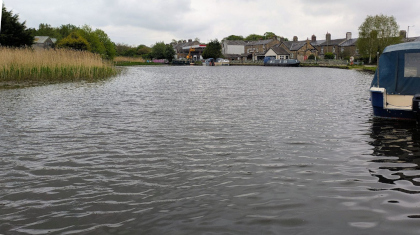 The cruise
Should you have read my efforts describing our cruise of the Lancaster Canal, you will be well aware of its idiosyncrasies.
It is a rarely used waterway and with little mooring for a narrowboat, and anywhere away from the official moorings is virtually impossible without a gangplank.
And even at some official moorings the boat can be grounded as it was somewhat deep draughted, and so a problem what attempting to moor. However it is a broad canal and wide, as can be seen, so when cruising it is possible to keep well away from the banks.
The hire boat
The likes:
The inventory—I told earlier about the inventory, and now counted no less than 111 items, in fact virtually everything that was needed for the cruise. Also included were supplies to last a couple of days to allow time to get to the shops.
Storage—the amount of storage space was more than sufficient for two, with lockers, drawers. cupboards and space under both the permanent bed and settee.
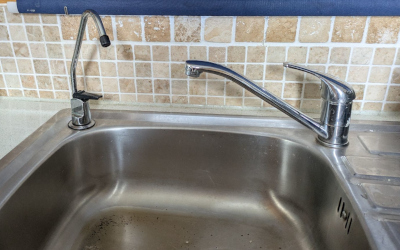 Water—the method of water to the sinks was exceptional. Having instant hot water to both, and adjustable to any temperature by turning the tap. But what was unusual was a separate tap that gave filtered water, as seen on the left of the picture. This was essential as a normal garden hose was used for filling, and there have been investigations suggesting that the black bits that break off their insides are cancerous.
Microwave—The microwave was an extreme luxury for us on a boat and working proficiently.
Shower—The shower was extremely modern, with the force of the water and its temperature adjusted by a simple control that was easily reached.
Toilet—The toilet was of the macerator type that quickly 'digested' everything, having a good seal, leaving no smell.
Heating—Heating was by three rather large radiators that were more than efficient for a 44 feet narrowboat.
The boat—has a decent 'swim' and progresses through the water quite well and is responsive to the tiller.
When we eventually finished the two owners brought two trolleys and moved everything from the boat to the car—that was appreciated.
 The dislikes
Sharp corners—the galley being 'U' shaped has three corners sticking out, they causing Thomas two particularly bad bruises that resulted in wrapping a tea towel around one particular nasty corner.
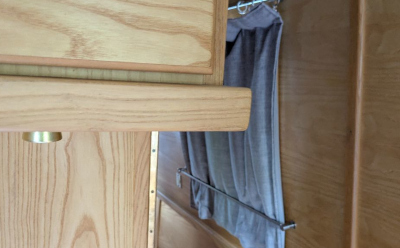
But by far the worst was the sharp end of the locker over the head of the bed (pictured) that caught all when anywhere near it, not helped by a very narrow corridor with two doors together sticking out making the corridor narrower still, near the protrusion.
If you come out of the toilet and turn around your head strikes it, and getting in or out of bed was a problem to remain unscathed.
Thomas had no exception but to turn the bed around so that his feet were by that corner, but of course loosing the lights provided for reading. Count was lost as to the number of times people were caught by the offending protrusion.
Interior—is cramped especially the passage that runs through most of the boat and way off the two feet norm.
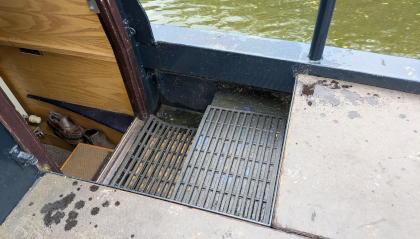 Stern deck—with not having the usual hatch there was a cavity in the stern deck to take the steps into the boat, that were awkward to negotiate.
When this part of the deck was nearest the bank—as we began our cruise back, it left just six inches of steel to step onto, that was a right bind when the boat was on the bottom and the gangplank used, leaving a space between the boat and bank.
This being particularly difficult for our Ridgeback Beth. She would not jump off the deck across the large cavity onto the six inches, but instead jumped off the step below the deck—and injuring herself in the process, her then being lame.
This meant we had to get moorings where we could get right up to the bank, and then she could work it out to get off from the lowered step straight on to the bank and back again.
 The conclusion
With the exception of these two problems, and though there were little idiosyncrasies (with the weed hatch being one somewhat in contrast to our own boat's normal, and much lighter one) some to the hire boats' advantage, it being recently refitted, so there were no other real complaints from us.
We had a most relaxed cruise. Just ambling along in the mornings enjoying the new scenery, it being a real holiday for all.
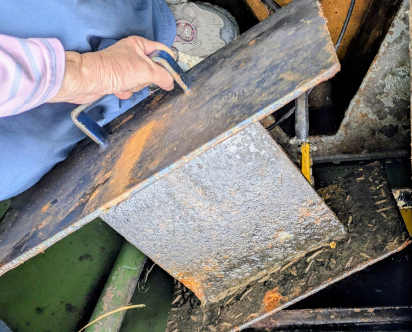
But I do believe that if the water for the radiators were coupled to that of the engine, they could be warm all the time, thus saving power to switch then on to warm a cold boat, this was something we missed, yet it only needs a couple of connections and a length of pipe.
So let's get back to the nitty gritty
Yes indeed, so what has the past fortnight brought.
Not such news on the stoppages front I'm afraid for April, with a real new record—as a total of 48 stoppages! The most ever recorded in a single month. And these did not include such as vehicle strikes that are no fault of Canal & River Trust.
But did include low water—11 stoppages. Broken paddles—nine stoppages.
Even this month, already 11 stoppages in the first week. All I can add is that it was a good job we took to the Lancaster Canal for our Spring cruise, unlike the cruise last September that stopped us at Alrewas from Mercia.
I really have to feel for those out now on the system, particularly on the northern waterways, especially the Leeds & Liverpool that already this month has six closures!
But a total of 59 stoppages in five weeks—just how can anyone plan a cruise with confidence?
These are facts my friends, cutting out the usual blarney that we suffer every month from the trust.
And how on earth has this happened—possibly too much spend on non-cruising trappings and all the many people concerned with implementing them.
Victor Swift—telling tales for 26 years