
“Waterways are the lifeblood of our country, but we are failing to give them the care, protection and investment they deserve." tells Griff Rhys Jones.
The Inland Waterways Association (IWA) is arguing that Britain’s 5,000-mile navigable network must be recognised as vital climate infrastructure, with sustained investment and a national strategy to protect it from increasingly severe droughts, flooding and extreme weather.
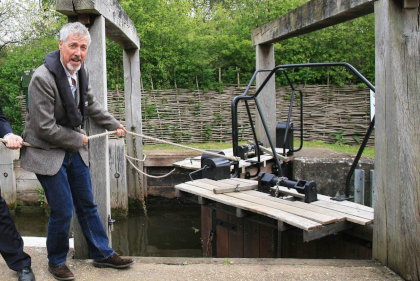
Griff Rhys Jones opens Flatford Lock. Credit: Emrhys Barrell
This is the conclusion of Waterways for the Future [1], a new report from IWA, which warns chronic underinvestment and a changing climate place the future of the 5,000-mile navigable network at risk. Following the driest April to September period in over a century [2], IWA is calling for the recognition of the role inland waterways play in adapting to these challenges.
Britain’s waterways are described as the “lifeblood of our country” by actor and presenter Griff Rhys Jones, who joined the call backing for government action. He relates:
“Our waterways are precious, beautiful and full of potential.
“In an age when environmental awareness should be at the forefront of decision-making, the decline of these vital natural assets is simply unacceptable. Our waterways have a future, but we must act now to protect them.”
However, the report also identifies major opportunities. With the right investment and joined-up planning, waterways will play a significant role in securing drinking water supplies, managing flood risk, reducing carbon emissions, boosting local economies and creating greener, healthier communities.
Based on the report’s findings, IWA calls on the government to prioritise 5 areas:
1. Recognise waterways as climate infrastructure.
Canals and navigable rivers must be valued not just as heritage and leisure assets, but as essential infrastructure that can support climate adaptation, water security, flood resilience, biodiversity and the transition to Net Zero.
2. Establish a Defra-led review of England’s and Wales’s inland waterways by 2028.
The Department for Environment, Food and Rural Affairs should lead a cross-departmental review to develop a long-term investment plan, bringing together the departments responsible for transport, energy, planning, communities and heritage. The Scottish Government should undertake a corresponding review of its waterways.
3. Devolve waterway powers and integrate waterways into local climate plans.
Mayors and strategic authorities should have the powers and flexible, long-term funding to incorporate canals and rivers into local climate adaptation, regeneration, transport and economic development plans. This would help communities make better use of the waterways on their doorstep.
4. Put canals into national water-security planning.
Existing waterways could help move water between regions experiencing different levels of water stress and shortage. Government should incorporate canals into national water-resource planning and support feasibility studies, pilot projects and modern monitoring systems, with safeguards for navigation, wildlife and heritage.
5. Make climate resilience a funding criterion.
Public investment decisions affecting waterways should explicitly consider the need to prepare infrastructure for future climate conditions. Reservoirs, feeder channels, embankments and other critical assets need sustained investment to withstand more frequent droughts and heavier rainfall.
Bill Esterson, MP for Sefton Central, and Chair of the All-Party Parliamentary Group on Waterways, explained:
“Waterways are a valuable resource for leisure, active travel, industry, energy, and more. The tranquillity experienced by water, along with the wildlife that thrives around clean waterways, is to be cherished and enhanced. But as well as being a treasured part of our heritage, they are a national asset with enormous potential to help in climate change adaptation.
“This is why this report is a timely reminder not just of what our waterways can do, but how they can be further utilised.”
Waterway closures caused by drought are now a staple of British summers, while increasingly intense rainfall threatens ageing embankments and other structures, as seen in two major breaches in the North West last year. Navigation authorities face rising repair costs and difficult funding decisions, leaving the network increasingly vulnerable.
The consequences extend beyond leisure boating. Waterways support tourism and local businesses, provide accessible green and blue spaces, sustain wildlife habitats and can move low-carbon freight, as well as renewable energy and low-carbon heating and cooling.
The report follows IWA’s previous landmark report Waterways for Today, which set out the case for investing in the network’s existing benefits. Waterways for the Future looks further ahead, making the case for how a more resilient waterway network can help meet the challenges of a changing climate.
Charlie Norman, Director of Campaigns and Public Affairs at IWA, reports:
“The potential of our waterways cannot be realised while the infrastructure is exposed to drought, flooding and decades of underinvestment. We need government to take a joined-up, long-term view of our waterways because the role they can play in water security, climate resilience and sustainable growth is deeply significant, and at the moment, pitifully under-valued.
“They have a huge role to play in Britain’s future if we invest sensibly. Coordinated action now will safeguard the network for generations while unlocking wider benefits for communities, the environment and the economy. It's why a Defra-led long-term development plan is needed.”
The report concludes that the future of Britain’s waterways should not be determined by the pressures of today. With the right policies and timely investment, they can and should be a central part of a more climate-resilient nation.