
EASTER BOAT GATHERING launches the Golden Anniversary Year at National Waterways Museum.
 Special Easter Boat Gathering
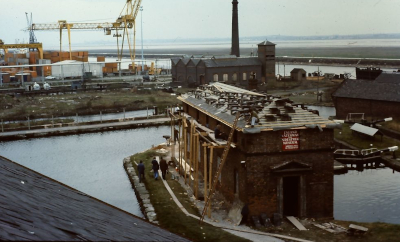
A special Easter Historic Boat Gathering in early April will herald in an exciting year of 50th birthday celebrations at Ellesmere Port’s National Waterways Museum. The image shows the creation of the museum.
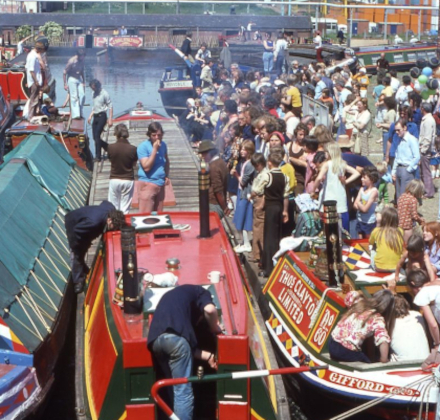
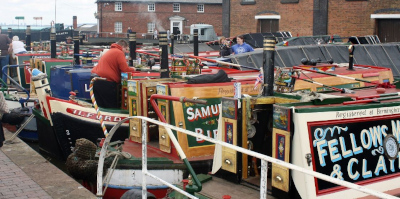
Organised by the Canal & River Trust, the popular annual event (3rd to 6th April 2026) will this year welcome around 40 colourful narrowboats and barges from across the country to the Cheshire museum, which is home to the nation’s largest collection of historic boats.
Gifford, a former horse-drawn tar boat, will be one of the stars of the show as it celebrates its own 100th birthday with a fresh coat of paint by expert canal boat artist Phil Speight, who was awarded an MBE in 2024 for services to heritage crafts.
One of the highlights of the weekend will be a chance to pick up expert tips and techniques from Phil at ‘Roses and Castles’ canal art painting demonstrations on Easter Saturday and Sunday.
 Good Friday
The Easter Gathering weekend starts at 11am on Good Friday, with the arrival of a spectacular historic boat flotilla along the Shropshire Union Canal. Visitors can then enjoy four days of fun boat trips, horse boating, harnessing and lock demonstrations, live music, craft workshops, stalls and family activities.
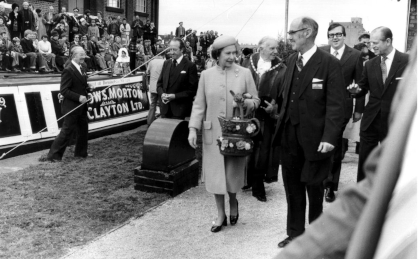
Later in the year, special events will include a fabulous, quirky Steampunk Weekend (18th and 19th April), special Golden Anniversary celebrations (12th to 14th June), a Vintage Vehicle Weekend (27th and 28th June) and World Chocolate Day (Sunday 5th July), as well as costumed characters bringing the old docks to life on several Canal Town Sundays through July and August. The image shows the Queen at the museum in 1979.
On offer will be new exhibitions, a family-friendly trail and tours of the museum, which has been used as a location for TV blockbusters such as ‘Peaky Blinders’ and the new Netflix ‘House of Guinness’ series.
 The anniversary is also being marked by several restoration projects, including a Historic England-funded renovation of the site’s Grade II Listed Pumphouse, which houses an impressive Victorian steam engine that once powered dock machinery for nearly a century.
Preservation work
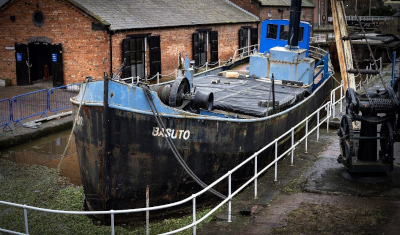
Preservation work will also be taking place on two important National Historic Fleet registered boats—Gifford and Basuto, the oldest surviving Forth & Clyde puffer boat (named due to the puffing sound of her steam engine). The image shows Basuto undergoing work.
Canal & River Trust North West director Jon Horsfall explains:
“The National Waterways Museum at Ellesmere Port plays an important role in preserving some of our nations' key historic boats and explaining the important story of how our canals made a vital contribution to Britain’s Industrial Revolution.
 We owe an immense debt of gratitude to those early volunteers in the 1970s, whose inspired determination to preserve the past resulted in the restoration of some of the wonderful port buildings and canal features we enjoy today.
“Now in 2026, volunteers still make a valuable contribution to the running of the seven-acre site, working alongside our staff to welcome more than 20,000 visitors a year. During our special anniversary it would be great to see even more people enjoying a fantastic visit to our superb waterside museum.”
Passionate canal enthusiasts
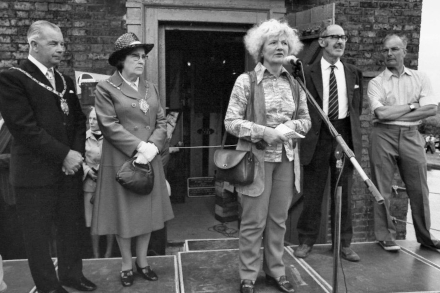
The idea for a new waterways museum was first floated in September 1970 at a meeting of passionate canal enthusiasts. The ‘North Western Museum of Inland Navigation’ society was launched a year later. Volunteer work parties began to restore the site at the junction of the Shropshire Union Canal and the Manchester Ship Canal/River Mersey, and in June 1976, the new ‘Boat Museum’ was officially opened to the public by canal campaigner and author, Sonia Rolt. Depicted in the image above.
Since then, the museum has hosted over a million visitors and highlights have included a visit by HM Queen Elizabeth II and the Duke of Edinburgh in 1979, and a ‘Museum of the Year’ award from the Council of Europe in 1984.
 In 1999, The Waterways Trust, a charitable arm of British Waterways, was invited to step in to manage the museum, linking it with similar museums at Gloucester Docks and Stoke Bruerne to become a new ‘National Waterways Museum’. In 2012 the Canal & River Trust charity took over responsibility for the museum, along with 2,000 miles of inland waterways in England and Wales.
Remarkably still volunteering half a century on are Hoylake couple Mike and Cath Turpin, who regularly devote two or three days a week to the museum. The image shows the celebrations in 1976.
Securing decaying buildings
Former teacher, Cath told:
“I’ve been proud to be part of something very special that continues to have relevance. Our early tasks included securing the decaying buildings against vandalism and looking after the increasing number of boats being acquired by the museum. We also got involved in fundraising. It was the industrial heritage that drew us in. This museum tells the stories of working boats and people that so often go unmentioned.
 “I am still involved in the hands-on work and Mike volunteers with the collections and archive team, and on boat and lock demonstration activities. I volunteer in the archive and engage with visitors providing boat commentaries, talks and guided tours. There’s always something to do!”
The Canal & River Trust would be delighted to hear from anyone wishing to support the charity by donating or joining the enthusiastic volunteering team at the museum. The image shows the boats at the museum.
For more information about visiting and to book discounted tickets and workshops, visit the museum website:
https://canalrivertrust.org.uk/places-to-visit/national-waterways-museum. The National Waterways Museum, Ellesmere Port, is open 10am – 4pm, five days a week during the winter (Wednesday – Sunday), six days in spring/summer (Tuesday to Sunday) and every day during bank holidays and school holidays.
Museum History—Key Dates
1970 Creation of a new waterway museum discussed at a meeting of canal enthusiasts in the Ring O’Bells pub in nearby Daresbury on 29 September.
1971 Inaugural meeting of the ‘North Western Museum of Inland Navigation’ (NWMIN) at Manchester University.
1974 First working party at Ellesmere Port site, led by Tony Hirst.
1976 Boat Museum officially opened by canal campaigner Sonia Rolt, widow of Tom Rolt, one of the founders of the modern canal restoration movement. Staffed entirely by volunteers.
1977 First Easter Gathering of historic boats.
1979 Visit of HM Queen Elizabeth II and Duke of Edinburgh to Museum on 2 November.
1981 Creation of the Boat Museum Trust to run the museum. Financial support from Ellesmere Port and Neston BC, Cheshire County Council and NWMIN.
1981 NWMIN buys 10 Porters Row. Derelict Land Grant finances the restoration of the Island Warehouse and a new exhibition.
1981/82 Toxteth riots in Liverpool prompt the creation of a new Merseyside Taskforce, which leads to Government funding for the restoration of the remaining dock buildings. Visits from Michael Heseltine and PM Margaret Thatcher.
1984 The Museum is awarded the Council of Europe ‘Museum of the Year’.
1987 Opening of the Porters Row houses to the public.
1990 Opening of the David Owen Archive (now National Waterway Archive) on the ground floor of the restored slipway workshops by the Duke of Westminster.
2000 The Museum is rescued by The Waterways Trust, a charitable arm of British Waterways, after it experiences financial problems. It joins with waterways museums in Gloucester and Stoke Bruerne to become the National Waterways Museum.
2003 Heritage Lottery Funding is secured to revamp the Island Warehouse exhibition, shop and café.
2009 The Heritage Boatyard is opened.
2012 The British Waterways’ archive collection is moved from Gloucester to an expanded archive facility at Ellesmere Port.
2012 The Canal & River Trust charity is created from British Waterways and The Waterways Trust and takes over management of the National Waterways Museum and Archive.
2017 The Big Lift. Many sunken boats from around the port were craned out and moved to a warehouse on nearby Rossfield Industrial Estate for conservation.
2023 Museum trip boat refurbished and run by volunteers.
2026 50th anniversary celebrations.